
HBOT vs. Off-Label Pharmaceuticals: Why Veterans with TBI and PTSD Deserve Better Options


For more than two decades, the VA has consistently labeled hyperbaric oxygen therapy (HBOT) as “unproven, unsafe, and untested” for traumatic brain injury (TBI) and post-traumatic stress disorder (PTSD). Yet the same system routinely prescribes a wide range of off-label medications—drugs never FDA-approved for these conditions—to treat the very same veterans.
This inconsistency raises an important question: If the VA accepts off-label drugs with limited or mixed evidence and known risks, why reject a therapy that uses FDA-cleared chambers and 100% oxygen (an FDA-approved “drug” when delivered under pressure)?
Here’s the factual comparison.
No FDA-Approved Drugs for TBI
There are zero medications FDA-approved specifically to treat TBI. All pharmacological approaches in the VA/DoD are therefore off-label and symptom-directed only.
Limited FDA-Approved Options for PTSD
Only two antidepressants—Zoloft (sertraline) and Paxil (paroxetine)—carry FDA approval for PTSD. Everything else used in VA/DoD clinics falls outside approved indications.
Common Off-Label Medications Used by VA/DoD
For PTSD (per 2023 VA/DoD Clinical Practice Guideline):
Atypical antipsychotics (quetiapine, olanzapine) – “insufficient evidence”
Tricyclic antidepressants (amitriptyline, imipramine)
Bupropion, mirtazapine, nefazodone, phenelzine (MAOI)
Prazosin (supported only for nightmares, not global PTSD symptoms)
Buspirone and beta-blockers (evidence lacking)
Risperidone – now actively discouraged
Benzodiazepines – explicitly recommended against due to dependency, cognitive risks, and interference with therapy
For TBI (mild TBI guideline):
NSAIDs (ibuprofen, naproxen) for headaches
Short-term low-dose opioids for acute pain
Caution or avoidance of antipsychotics and benzodiazepines due to seizure risk and cognitive side effects
These are not fringe practices—they are standard VA/DoD care when evidence-based options fall short.
The Human Cost of the Current Approach
From 2006 to 2014, just four of the eight VA Consolidated Mail Outpatient Pharmacies (CMOPs) distributed more than 847 million opioid pills. By the fourth quarter of 2012, the VA reported 679,000 veterans with opioid use disorder.
Nationally, veteran suicides have reached approximately 153,000 and opioid overdose deaths exceed 109,000 in recent decades. While many factors contribute, the heavy reliance on off-label psychotropics and opioids cannot be ignored.
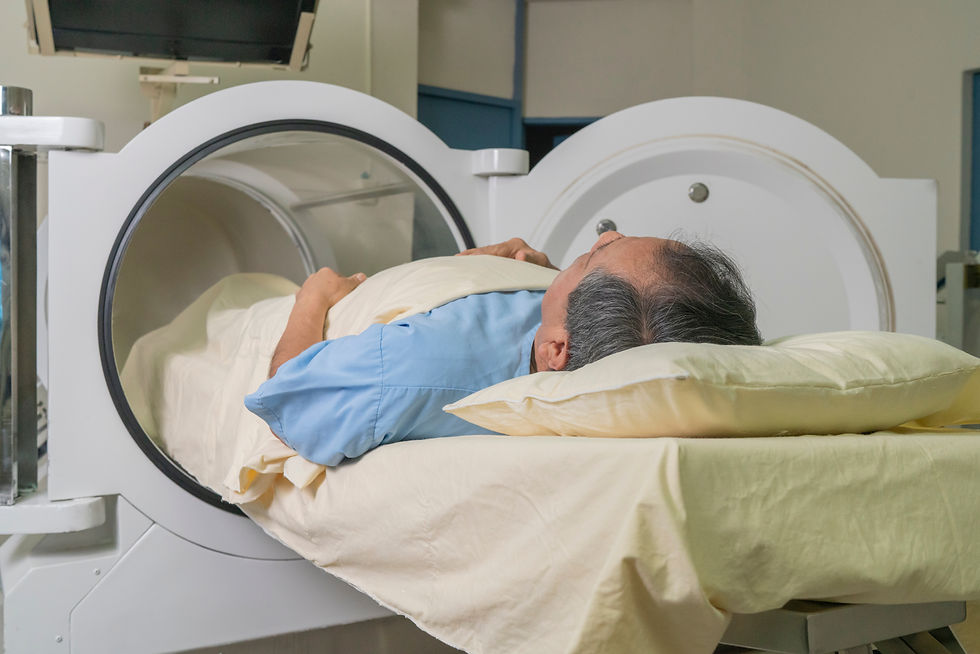
HBOT: A Different Category Altogether
HBOT is not an experimental drug. It is:
Delivered in FDA-cleared hyperbaric chambers
Uses 100% medical-grade oxygen (explicitly FDA-recognized when used in this manner)
Has been standard-of-care for decades for other brain injuries, including carbon monoxide poisoning and decompression sickness
Covered by CMS (Medicare/Medicaid), the Undersea and Hyperbaric Medical Society (UHMS), and major insurers for approved brain-injury indications
In short, HBOT is already an FDA-recognized and CMS-reimbursed therapy for certain neurologic injuries—unlike the off-label pharmaceuticals above.
Why HBOT Offers a Stronger, Regenerative Alternative
While off-label drugs primarily mask symptoms (and often carry dependency, cognitive, or metabolic risks), HBOT addresses underlying biology:
Corrects tissue hypoxia
Reduces chronic inflammation
Promotes neuroplasticity, stem-cell mobilization, and angiogenesis
Improves cerebral blood flow and mitochondrial function
These mechanisms have been documented in peer-reviewed studies for TBI and PTSD (many already available in the SCI-DI research library), with benefits persisting years after treatment.

A Call for Consistency and Veteran-Centered Care
If the VA/DoD can justify off-label prescribing of antipsychotics, TCAs, and opioids—therapies with documented serious risks and no FDA approval for TBI—then HBOT, a therapy with an 89-year safety record in brain injury and regulatory approval for related neurologic conditions, deserves fair consideration.
Veterans deserve access to every safe, evidence-supported tool. At SCI-DI, we believe that includes hyperbaric oxygen delivered in FDA-cleared chambers by trained professionals.
Explore the Evidence Yourself Our free HBOT Research Library includes dozens of peer-reviewed papers on HBOT for TBI and PTSD, including randomized trials, SPECT imaging studies, and long-term outcome data. Download them at no cost and share with your care team.
Healing is possible. Let’s move beyond symptom management and give veterans therapies that actually support brain repair.
Questions or ready to discuss HBOT options? Contact the SCI-DI team today. We’re here to help veterans and their families navigate the science and access care.


Comments